Trusted by 850+ brands across 42 countries

Miinto
mejuri
rapha
dott
Mytheresa
monica-vinader
gls
allsaints
monese
outnorth
mindful-chef
charles-tyrwhitt
clubl
freddie's flowers
PastaEvangelists
loaf
oliver bonas
mammut
qpark
fabfitfun
adanola
organicbasics
mammaly

What Mim handles, so your team doesn't have to

Tools that help agents respond faster and deliver better customer experiences.

Learns from your content

Mim reads your knowledge base, website, and policies; no manual training, accurate answers from day one

Resolves requests end-to-end

Process refunds, cancel orders, update shipping. Customers get what they need without waiting for a human

Works across every channel

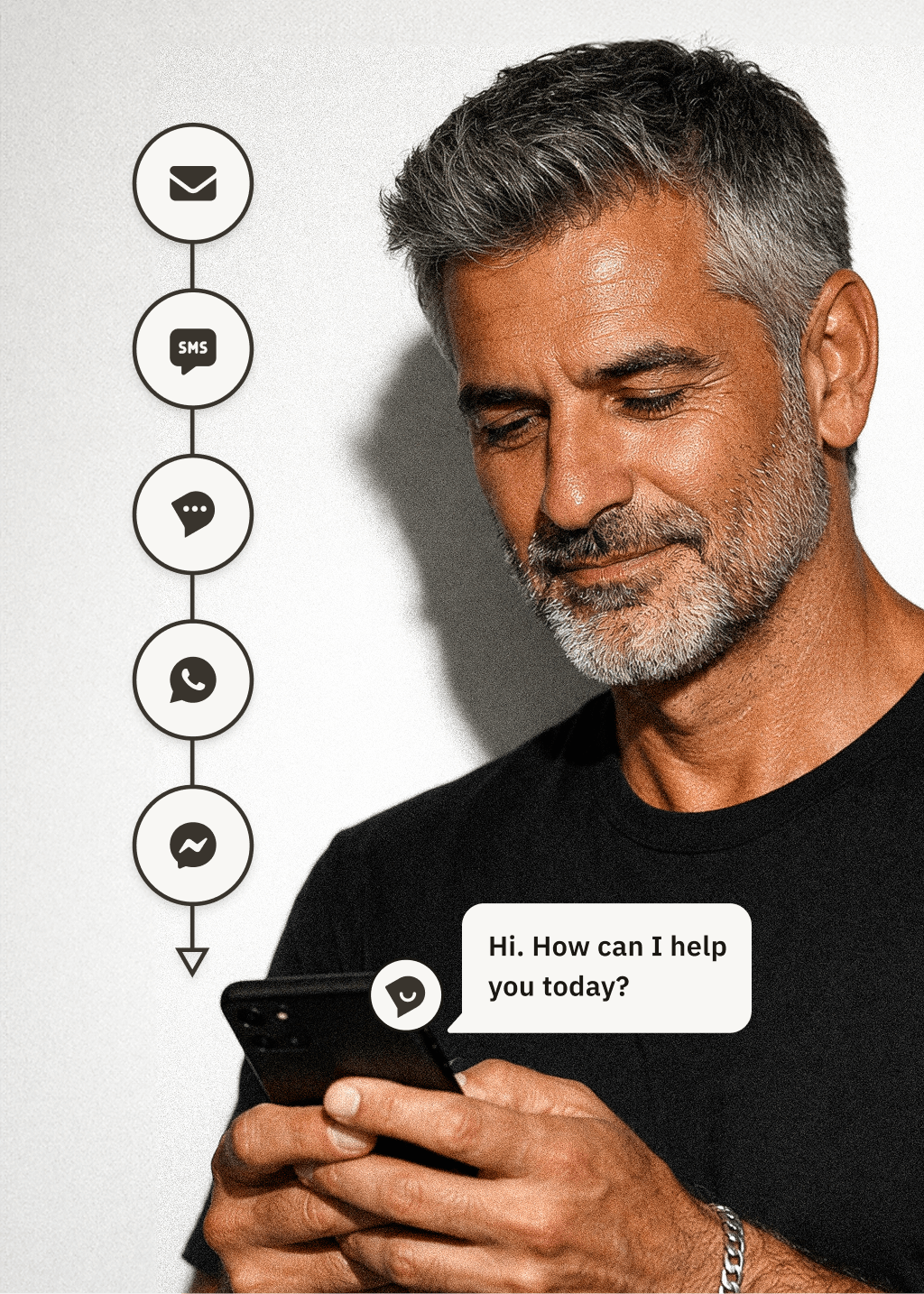
Chat, email, WhatsApp, Messenger, SMS –one setup, same quality everywhere your customers reach out

Hands off with full context

When something needs your team, they get the full conversation and customer data instantly

Follows your logic

Mim uses procedures and tools to take action the way you would, not just surface articles

Always on

Peak season, overnight, weekends; customers get instant answers even when your team is off

The conversation ends with a resolution, not a redirect

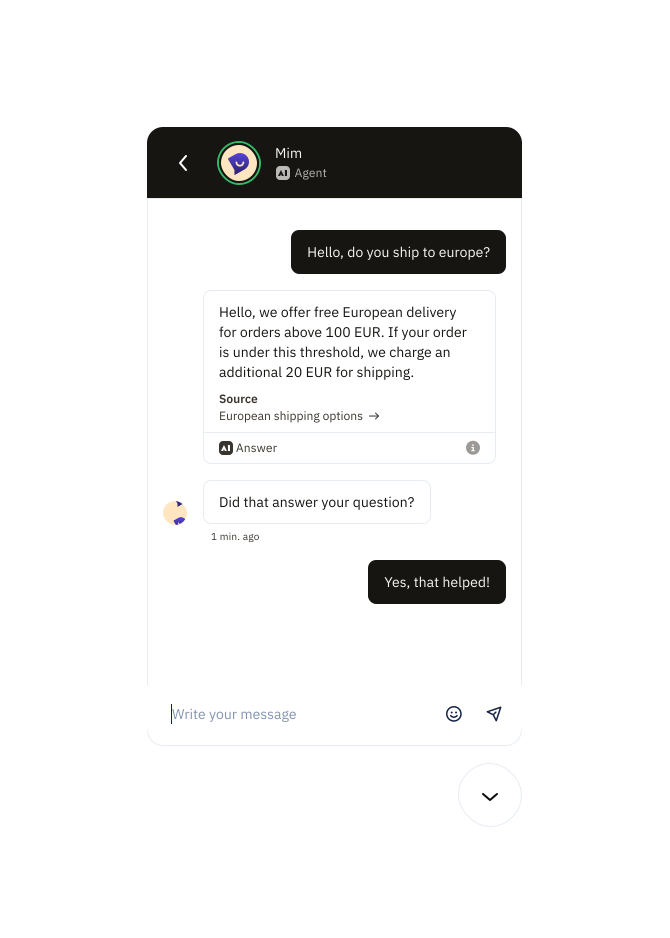
Mim observes the conversation, reasons through your knowledge base and policies, decides what to do, and executes; processing refunds, updating orders, answering questions. No scripted responses. Real decisions.

  • Learns from your knowledge base and website automatically
  • Takes action based on your procedures, not just keywords
  • Uses context from previous conversations and customer data

Image Description

One AI that shows up wherever your customers do

Customers reach out however it's convenient for them. Mim meets them on live chat and email, and handles requests the same way every time.

  • Same resolution quality no matter how customers reach out
  • Add new channels without rebuilding
  • Set up once, no per-channel configuration

Escalations that don't start from scratch

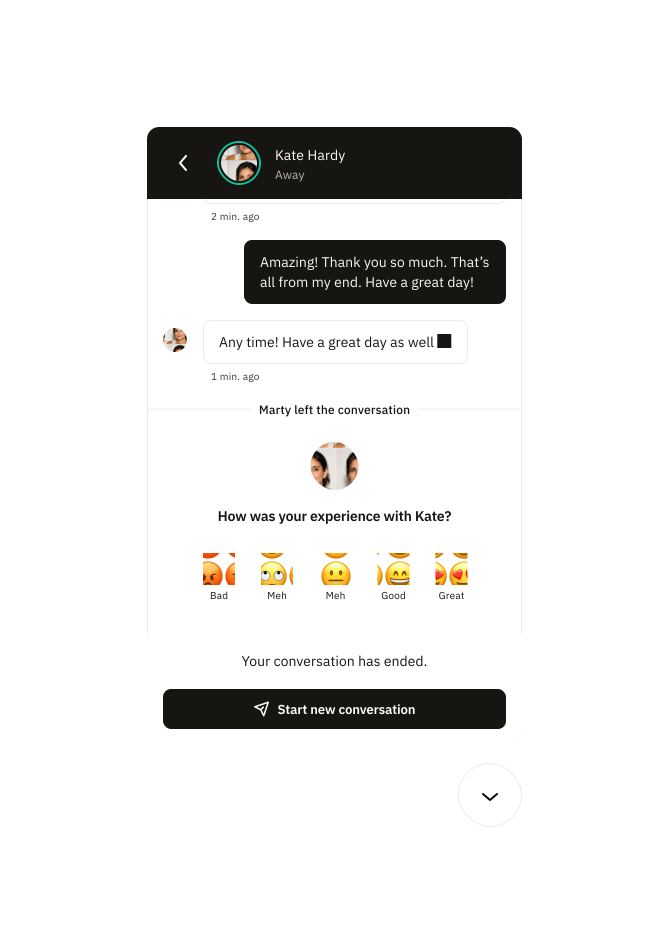
Mim knows when to escalate. When it does, your team gets everything: the full conversation, what Mim already tried, and all the customer context they need.

  • Full conversation history handed off automatically
  • Customer data and order details already loaded
  • No "can you repeat that?" – pick up where Mim left off

How Mim compares to traditional chatbots

Feature
Resolution approach
Actions
Knowledge source
Context
Channels
Handoff
Maintenance
Accuracy
Mim AI Agent
Resolves requests end-to-end
Processes refunds, updates orders
Learns from your content
Remembers previous conversations
One setup, every channel
Full context to humans
Updates with your content
Grounded in your knowledge
Traditional Chatbots
Deflects to FAQs or menus
Suggests articles
Manual scripting required
Starts fresh every time
Separate build per channel
Customer repeats everything
Separate queues
Often wrong or outdated
Dixa’s automation and incredible AI agent assistant have greatly enhanced our efficiency and productivity."
Erica Piccolomini
Chief Customer Officer at Stayforlong
Read the case study
Since partnering with Dixa, we've nearly doubled the workload achieved each day–resulting in extremely positive customer satisfaction and very happy teams."

Natasha Sims
Operations Director at Oliver Bonas
Read the case study
To enhance our CX, we knew that the business needed a unified platform to reduce silos across channels and teams. Dixa's one-screen wonder has been a game changer that keeps our workflows seamless."

Rhys Howells
Head of Customer Service at Rapha
Read the case study
-33%
contact per booking
-50%
email backlog
90%
CSAT
2x
productivity/hour
+14%
improvement in CSAT scores
+17%
increase in customer retention

Frequently Asked Questions

What's the difference between a chatbot and an AI agent?

A chatbot follows a script. It can only handle situations it's been explicitly programmed for — when it hits something outside that, it routes to a human or fails. An AI agent reads the situation, reasons through your policies, and acts. A chatbot tells a customer how to request a refund. An AI agent processes it. That difference in what actually happens at the end of the conversation is what makes the customer experience feel either resolved or frustrating.

What is an AI agent for customer service?

Software that handles customer inquiries end-to-end without a human — not by deflecting to articles, but by completing the actual task. Checking order status, processing a return, updating a shipping address, cancelling an order. Mim does this across chat, email, and messaging. When something genuinely needs a human, it escalates with the full conversation and customer context already loaded.

What does Mim actually do when a customer reaches out?

It reads the message, checks your knowledge base and policies, pulls relevant order or account data, decides what should happen, and does it. No keyword matching, no decision trees. If a customer says "my order hasn't arrived and I need it by Friday" — Mim checks the order status, understands the urgency, and responds with what's actually true and what options exist. If it can resolve it, it does. If it can't, it says so and hands off.

How is Mim different from Zendesk's Answer Bot or Intercom Fin?

Most AI tools in support are built to deflect — suggest an article, reduce ticket volume, hope the customer goes away. Mim is built to resolve — connect to your systems, complete the transaction, confirm it's done. It also lives inside Dixa's platform natively, so customer history, routing, and agent workspace are all the same whether Mim is handling the conversation or a human is. No seam between AI and human interactions.

What kinds of inquiries should still go to a human?

Complex complaints that need discretion, situations where a customer is visibly upset and needs to feel heard, exceptions to policy that need authorisation, anything ambiguous enough that a wrong answer would cause real damage. Mim is designed to recognise these and escalate rather than attempt them. The brands that get the best results are the ones that think carefully about where the line is — not trying to automate everything, but automating the right things.

Does it actually improve customer satisfaction or just reduce cost?

Both, but the mechanism matters. Speed of resolution is the biggest driver of CSAT for routine inquiries — a customer who gets their refund confirmed in 30 seconds doesn't feel like they had a worse experience because it was AI. The CSAT risk comes from wrong answers, dead ends, or an AI that tries to handle something it shouldn't. Rapha saw +14% CSAT after moving to Dixa. Oliver Bonas reached 90% CSAT while doubling agent productivity per hour.

How does it handle ecommerce specifically — returns, tracking, refunds?

Mim connects to Shopify and Magento to pull live order data and act on it. A customer asks where their order is — Mim checks the actual current status and responds. A customer wants a return — Mim checks your policy, initiates it, confirms. These query types make up the majority of ecommerce contact volume. Dott reduced response time by 70% and handling time by 40% using Mim across exactly these scenarios. Hobbii achieved an 81% self-service rate.

Can it handle the volume during peak season?

Volume spikes don't affect Mim the way they affect a human team. There's no queue limit on AI resolution, no seasonal hiring, no onboarding lag. Your human team absorbs only the contacts that actually need them — complex, exception-based, high-stakes. The brands that feel the biggest relief at peak are the ones who deployed before it, not during.

What does migration look like if we're coming from Zendesk or Gorgias?

Most Dixa customers come from Zendesk, Freshdesk, Gorgias, or Intercom. Implementation takes two to four weeks with dedicated onboarding support — knowledge base migration, integration setup, agent training. The transition is structured to maintain continuity. You're live before the old contract ends.

How quickly can Mim go live?

Days to two weeks for most customers. Mim learns from your existing knowledge base and website — no training data to build from scratch. Standard Shopify and Magento integrations are configured through guided setup. The main time investment is making sure your knowledge base is accurate before Mim starts handling live conversations. Dedicated onboarding is included.

How do I know if it's working?

Self-service rate — what share of inquiries Mim resolves without escalating — is the primary signal. You can also track CSAT on Mim-handled conversations versus human-handled, and time-to-resolution. Where Mim escalates most frequently tells you where your knowledge base needs work. A healthy deployment shows a rising self-service rate over the first few weeks as Mim encounters more of your real inquiry patterns.

Is this worth it for a team our size?

Depends on your contact mix more than your headcount. If a significant share of your volume is routine — order tracking, returns, FAQs — there's a strong case regardless of team size. If most of your contacts are complex or high-judgment, the case is weaker. Dixa works best for mid-market ecommerce brands where volume is growing faster than the team can absorb it without AI.

See what Dixa can do for you

Book a call with our team and discover how brands like yours handle more with less.

DixaDixa